Hierarchical automatic modulation classification with conditional cyclic-cumulant refinement
This paper proposes a hybrid hierarchical automatic modulation classification (AMC) algorithm that adapts computational effort to the discriminability of different modulation groups.
Here is the full citation and abstract:
Ruilin Wu, Xueyuan Liu, and Philip Leong. Hierarchical automatic modulation classification with conditional cyclic-cumulant refinement. IEEE Signal Processing Letters, 2026.
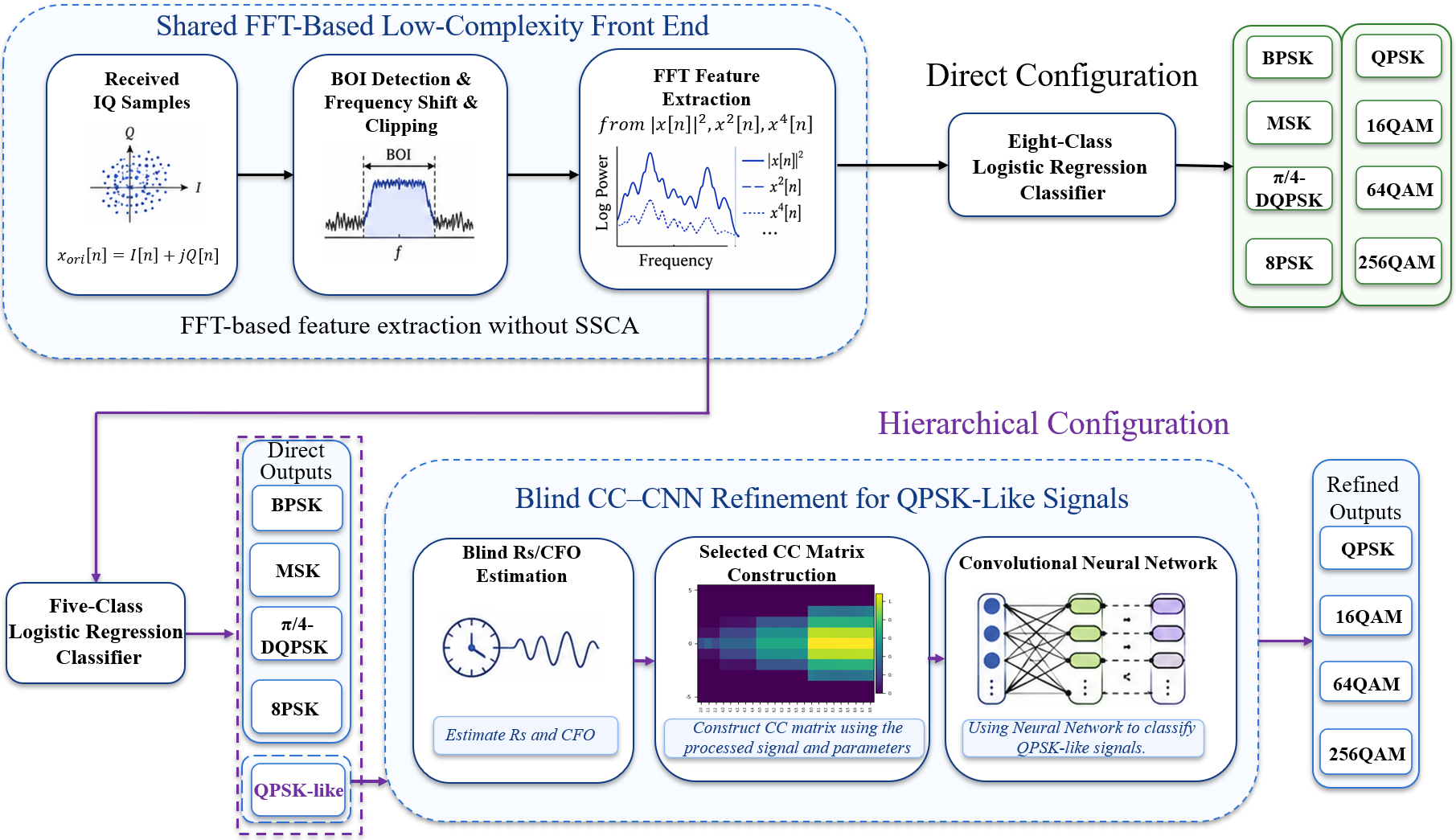
Cyclostationary features have shown robust cross- dataset generalization for single signals in flat channels, but higher-order feature extraction is costly. This paper proposes a hybrid hierarchical automatic modulation classification (AMC) algorithm that adapts computational effort to the discriminability of different modulation groups. A lightweight fast Fourier trans- form (FFT)–logistic regression (LR) classifier first separates the signals into BPSK, MSK, ω/4-DQPSK, 8PSK, and a QPSK-like family; for QPSK-like signals, blind symbol rate and carrier frequency offset (CFO) estimation, cyclic cumulant (CC) matrix construction, and convolutional neural network (CNN) classifi- cation are used to refine the classification into QPSK, 16QAM, 64QAM, and 256QAM. Experiments on the CSPB.ML.2018 and CSPB.ML.2022 datasets show that compared with the strip spectral correlation analyzer (SSCA)-based CC method, the proposed technique retains comparable same-dataset and cross- dataset accuracy while providing an estimated 7.20x operation speedup and an approximately 9.52x measured average CPU- latency speedup under the balanced eight-class setting. Ablation experiments show that direct eight-class classification using LR or a Multi-layer Perceptron (MLP) results in lower accuracy.